 AFA Connect
Why SDA’s Tranche 3 Ground Network Is a Resilience Test
SDA’s new Tranche 3 ground-entry-point competition shifts the resilience test from satellite numbers to an integrated, global data path.
By Joy Glip ·
Original AFA Connect reporting. Facts are attributed to the public records and reporting listed below. Report a factual error.
Sources and records
- SDA Requests Proposals for Resilient Missile Warning and Tracking LEO Ground Entry Points — Space Development Agency
- Missile Warning Satellites: Space Development Agency Should Be More Realistic and Transparent About Risks to Capability Delivery — U.S. Government Accountability Office
- SDA to Expand Ground Architecture for Missile Tracking Satellites — Air & Space Forces Magazine
- NRL’s Blossom Point Tracking Facility Provides Command and Control for Space Development Agency Tranche 0 Mission Launch 2 — Defense Visual Information Distribution Service / U.S. Naval Research Laboratory
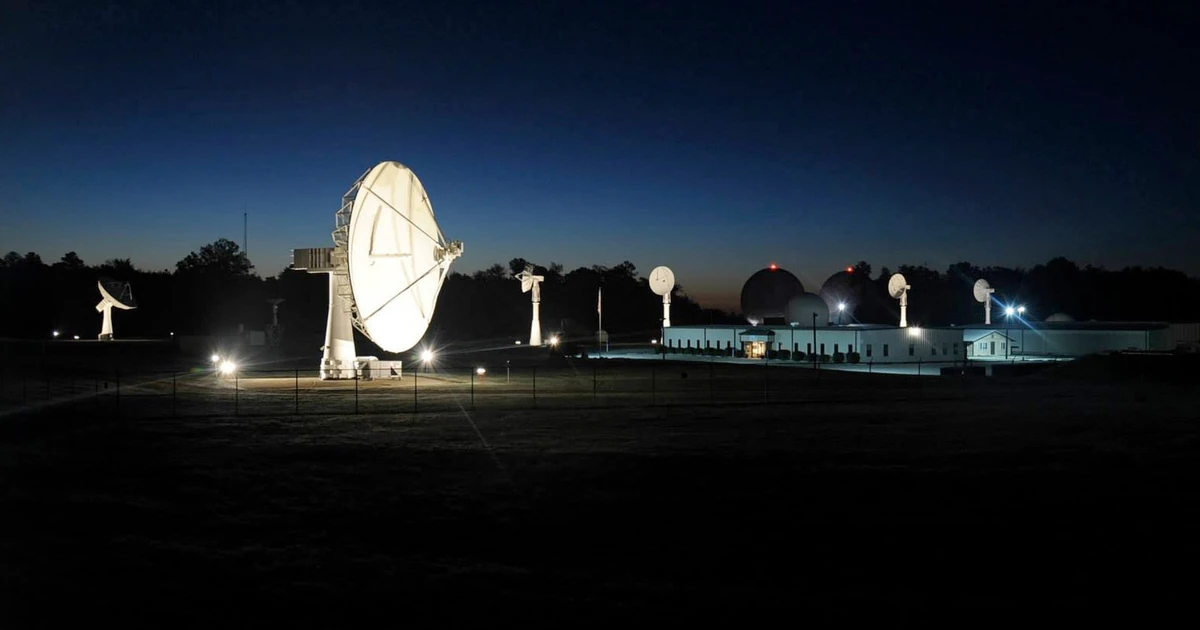
Image: U.S. Naval Research Laboratory photo via DVIDS (public domain)
The Space Development Agency is asking industry to build multiple, globally dispersed ground entry points for the missile-warning and tracking portion of its Tranche 3 constellation. That makes the new competition more than a facilities project: it is a test of whether a proliferated fleet in orbit can be matched by a resilient path for moving its data to users on Earth.
SDA posted the request on Sept. 18 and set a Nov. 2, 2026, 4 p.m. Eastern deadline for proposals. The published scope includes site preparation, communications shelters, antennas and associated electronics, optical terminals, and networking hardware and software.
The ground network is part of the warning chain
Putting more sensors in low Earth orbit does not by itself deliver a warning. The satellites must send usable information through a chain of ground systems, and those systems must exchange data quickly enough for military and national leaders to act.
A January 2026 Government Accountability Office assessment described that chain in detail. Contractor-specific systems called NOVAs are intended to receive two-dimensional tracks and relay them to SDA’s unified SUPERNOVA ground system. SUPERNOVA is then expected to distribute track messages and combine observations into three-dimensional tracks. GAO said those steps must occur in near real time to support timely threat assessment and decisions.
That architecture explains why geographic dispersion matters. Multiple entry points can provide more paths between a moving constellation and the terrestrial network. But dispersion creates its own burden: equipment, software and interfaces at separate sites still have to work as one operational system. Resilience therefore depends on both the number of locations and the consistency of the integration behind them.
Tranche 1 provides the caution
GAO found that earlier Proliferated Warfighter Space Architecture ground work encountered underestimated requirements and difficult integration. Its report said delays in contractor NOVA deliveries compressed test schedules, and that ground testing was not complete before the first Tranche 1 launch in September 2025. The watchdog warned that identifying defects after satellites are on orbit can bring rework, retesting, schedule delay or deferred capability.
The report also drew an important boundary around the program’s milestones. SDA planning documents showed that full missile-warning and tracking capability depends on satellites from Tranches 1, 2 and 3 operating with the Transport Layer and an operational ground segment. A successful launch is therefore progress, not the same thing as an end-to-end warning capability.
The Tranche 3 request appears to address a concrete piece of that dependency by seeking a globally dispersed set of entry points. It does not prove that the integration risk has been retired. The competition is still at the proposal stage, and the public notice does not announce an award, completed sites or operational performance.
What should be measured next
The most meaningful future evidence will be operational rather than architectural: whether entry-point locations are available when needed; whether optical, antenna and network components exchange data across vendors; whether test events cover the complete satellite-to-ground-to-user path; and whether ground readiness keeps pace with the planned Tranche 3 launch schedule.
Those measures also separate redundancy from resilience. Adding sites can reduce dependence on any one location, but only if the network can reroute work and preserve timely service when a component or connection is unavailable. The public record does not yet establish that outcome.
Air & Space Forces Magazine separately reported the ground-architecture expansion on Sept. 21. The accompanying photograph shows the Naval Research Laboratory’s Blossom Point Tracking Facility in 2016 as authentic context for satellite ground infrastructure; DVIDS does not identify it as a Tranche 3 ground entry point.