 AFA Connect
When an Air Force family needs to move early, which process applies?
A family hardship and a threat to a dependent’s safety can both lead to a move. Air Force policy gives them different starting points and decision makers.
By Joy Glip ·
Original AFA Connect reporting. Facts are attributed to the public records and reporting listed below. Report a factual error.
Sources and records
- Total Force Assignments, paragraph 6.54 and Attachment 15 — Department of the Air Force
- Military Personnel: Humanitarian Reassignments and Safety Transfers — U.S. Government Accountability Office
- Full report, including Air Force processes and data limitations — U.S. Government Accountability Office
- Incirlik Military Personnel Flight photo record — DVIDS
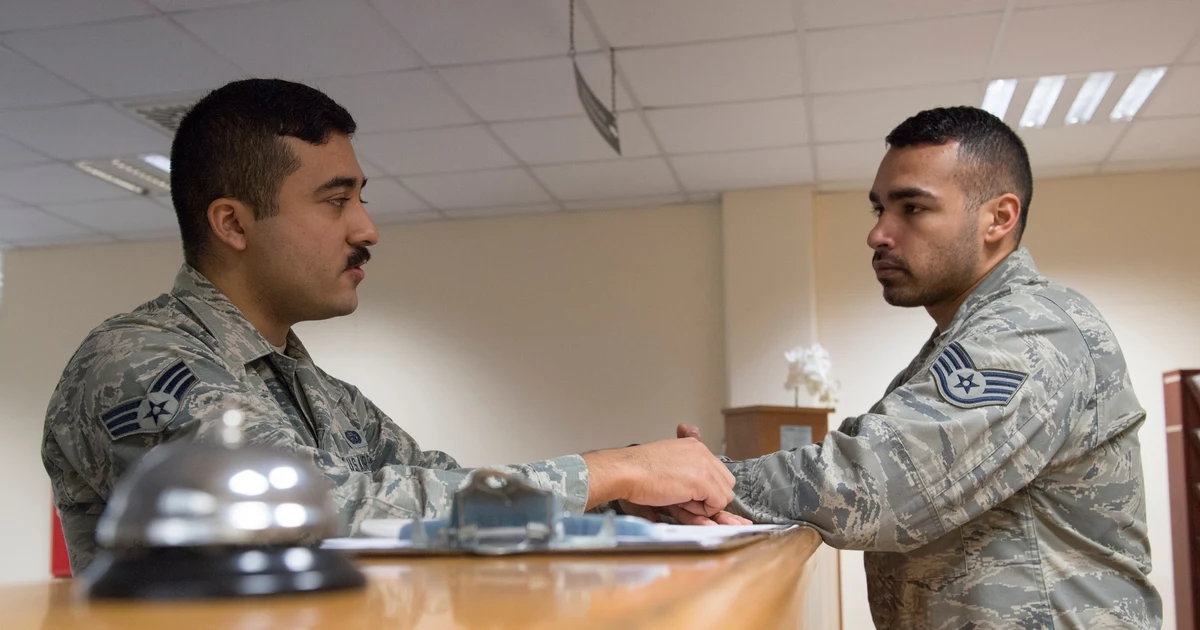
Image: U.S. Air Force photo by Senior Airman Kirby Turbak
An Airman who needs to be near a terminally ill parent and an Airman whose dependent faces a serious threat at home may both need orders to another base. Their requests begin in different places. In the first case, the service member assembles a humanitarian reassignment application. In the second, the command and installation authorities assess whether they can keep the family safe where it is.
A November 13 Government Accountability Office report traced both routes through the Air Force Personnel Center. For families trying to work out whom to approach, the most useful detail is who starts the paperwork and who has authority to decide.
When the issue is a family hardship
For Regular Air Force members covered by Attachment 15 of the Department of the Air Force assignments instruction, the usual starting point is the virtual Military Personnel Flight (vMPF). The member submits the application and supporting documents there. The instruction excepts members in initial technical training from that submission rule. The unit commander reviews it, recommends approval or denial and forwards it to AFPC. For a family dealing with serious illness, this is an important distinction: the commander’s endorsement gets the request to the people who evaluate the evidence. It does not issue new orders.
AFPC’s medical or legal officials review documents in their respective specialties. AFPC makes the final decision for most Air Force applicants. Requests involving colonels or chief master sergeants, including selectees for those grades, go on to the appropriate higher office. AFPC also processes requests for Guardians and forwards them for final adjudication. The instruction gives a family three practical questions to consider. Why is the Airman’s presence essential? Can the problem be resolved within a reasonable time, normally 12 months? If a move is necessary, is there a vacancy at the gaining duty station? A need for dependent medical services unavailable at the current assignment can fall under the Exceptional Family Member Program, which has a separate process.
When the issue is a threat to safety
The Air Force calls this the Threatened Persons Assignment Program. Officials told GAO that the unit commander, Security Forces, the Office of Special Investigations and the relevant staff judge advocate assess the situation. Paragraph 6.54 assigns the decision to request a transfer to the installation commander, or the air base group commander at a joint base led by another service. The unit commander participates in the assessment. The member does not file this as a humanitarian request in vMPF. If the installation-level commander requests the transfer, AFPC decides it. AFPC also implements an approved transfer.
The central question is whether other measures can protect the member or dependent at the current location. The report describes commanders receiving training and AFPC guiding them and members through individual cases. A family facing immediate danger should seek emergency help immediately. A reassignment request is a personnel decision that takes place separately.
What the approval figures tell a family
GAO found that annual Air Force humanitarian approval rates ranged from 66 to 83 percent across fiscal years 2022 through 2025. GAO groups Air Force and Space Force requests together because the Air Force processes both. A family cannot infer the likelihood of its own request from that range. The underlying cases involved different circumstances, and the report gives no case-specific prediction.
The Air Force lacked complete safety-transfer figures for the same four years. Its cases were therefore excluded from GAO’s chart of safety-transfer outcomes. The humanitarian approval range cannot fill that gap. For a family deciding where to start, the type of problem is more informative than either percentage: a hardship application begins with the member’s evidence, while a safety transfer begins with an assessment of the danger at the current duty station.