 AFA Connect
What the Pentagon’s Planned Autonomous Warfare Command Would Change
The Pentagon’s planned autonomy command could reshape joint requirements, acquisition and career fields, but Congress and a 30-day plan still stand in the way.
By Joy Glip ·
Original AFA Connect reporting. Facts are attributed to the public records and reporting listed below. Report a factual error.
Sources and records
- Project Agincourt — Pathway to the Autonomous Warfare Command — U.S. Department of War
- Hegseth Unveils New Autonomous Warfare Command in ‘State of the Force’ Address — Air & Space Forces Magazine
- Hegseth announces new four-star command for autonomous warfare — Army Times
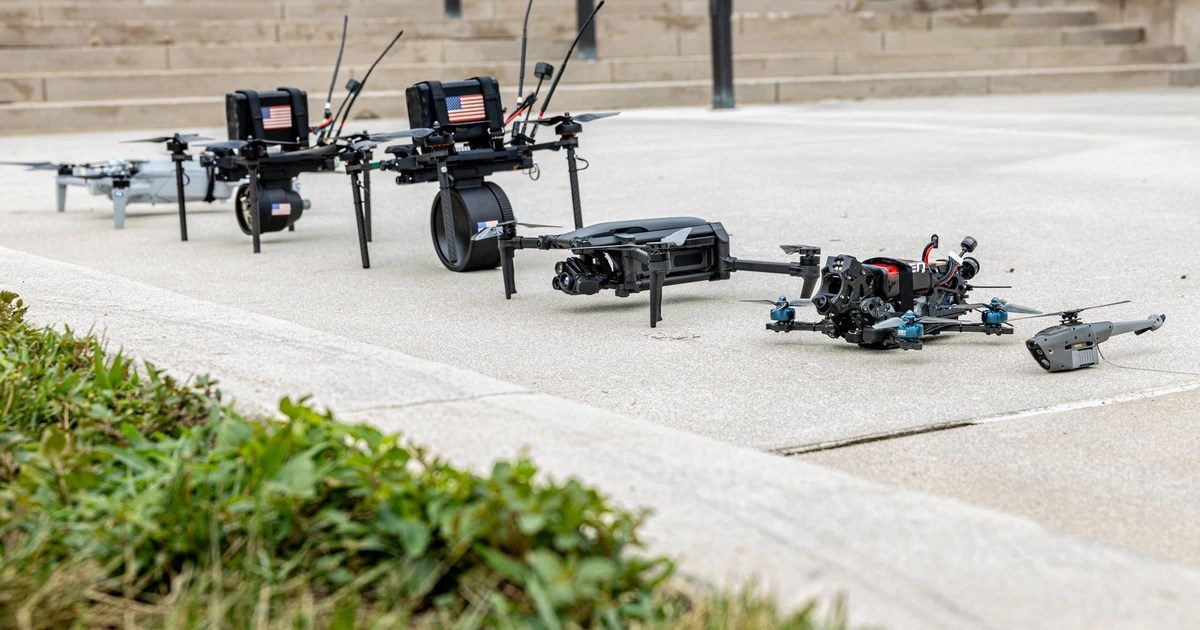
- U.S. Secretary of Defense Pete Hegseth Unleashes U.S. Military Drone Dominance [Image 10 of 10] — Defense Visual Information Distribution Service
Image: U.S. Marine Corps photo by Isaac Llanez Delgado via DVIDS (public domain)
The Pentagon has ordered a path toward an Autonomous Warfare Command, but it has not yet created the finished command that the name suggests. A Sept. 30 memorandum directs an interim effort called Project Agincourt to build the plan, seek legislation and begin work under existing authorities. The distinction matters: the document establishes a transition mechanism and a target, not a fully staffed headquarters with settled command relationships.
The official memorandum describes the future organization as a functional combatant command that would lead the joint force in unmanned and autonomous warfare. It says the command would have directed manpower, budget and acquisition authorities and would create dedicated officer and enlisted career pathways. The target establishment date is Oct. 1, 2027, and the department says it must work with Congress to secure necessary legislation.
The first deadline is 30 days, not one year
The most consequential near-term requirement is a plan of action and milestones due within 30 days. The order says that plan must identify service force contributions, force-generation responsibilities, command relationships, resources, required authorities and milestones. It must also define an initial operating capability and identify measures of adaptation and service adoption.
That list is effectively a map of the unresolved questions. The announcement does not establish how much personnel or funding each military department would supply, which existing autonomy programs would move, or how authority would be divided between the new command, the services and geographic combatant commanders. The memorandum explicitly tells planners to present alternatives and recommended decisions where choices remain unresolved.
Air & Space Forces Magazine reported that the Senate had proposed such a command during work on the fiscal 2027 defense policy bill, but that legislation was still pending. That makes congressional action more than a procedural footnote. A combatant command with the stated authorities cannot be evaluated only by its title; the final statutory language, resources and command relationships will determine whether it changes fielding speed or adds another headquarters layer.
Project Agincourt is the immediate operating experiment
The memorandum assigns Project Agincourt to the Direct Reporting Portfolio Manager for Unmanned Systems, or DRPM-UxS. It names Defense Innovation Unit director Owen West and Navy SEAL Senior Chief Max Strasiser as the portfolio organization’s chief executive officer and chief operating officer, respectively. Initial work is to proceed under existing authorities while the department builds the longer-term command proposal.
The acquisition concept is broader than buying a particular drone. The order calls for operators, innovators and competitive manufacturers to work in rapid cycles; decisions and money would move closer to operational forces; and systems would be tested against realistic opposition, modified quickly and scaled when they work. Army Times described the same approach as “warfighting acquisition” and reported that training exercises—and combat when possible—would be used to determine which technologies merit expansion.
The test, then, is not whether Project Agincourt can stage a fast demonstration. It is whether the department can repeat the cycle while preserving safety, test rigor, cybersecurity, interoperability and accountable spending. Speed without a durable method would produce isolated successes rather than a joint acquisition system.
What this could mean for Airmen and Guardians
For the Air Force, the proposed command would arrive while autonomous Collaborative Combat Aircraft and other unmanned programs are already being developed through service acquisition and operational experimentation. The official order says the future command would define joint needs and integrate service-provided forces in support of geographic combatant commanders. That wording suggests a joint demand-and-integration role, while the services would still provide forces. It does not establish that Air Force programs have been transferred.
The personnel direction could be equally important. The military departments must propose phased manning plans and identify how to establish or adapt specialties, ratings or equivalent career fields for unmanned and autonomous systems. For Airmen and Guardians, that raises practical questions about who operates, maintains, secures, tests and commands autonomous capabilities—and whether technical expertise can progress through a career without being treated as a temporary assignment.
The Space Force is not assigned a specific program in the memorandum. Still, a joint command built around autonomous systems would depend on communications, positioning, sensing, data transport and resilient command and control. Those dependencies make space integration relevant, but the public record does not yet say what forces, billets or authorities the Space Force would contribute.
The difference between a command and a capability
A new headquarters can align requirements and concentrate accountability, but it cannot by itself solve production capacity, software assurance, contested communications or the cost of sustaining large autonomous fleets. The memorandum’s monthly reporting requirement—covering operational results, service adoption, progress and unresolved decisions—offers an early measure of whether Project Agincourt is changing outcomes rather than only organization charts.
The next evidence should be concrete: the 30-day plan, proposed legislation, an identified initial operating capability, resource decisions and a clear division of responsibility with the services. Until those appear, the Autonomous Warfare Command is best understood as a consequential reorganization proposal with immediate experimentation underway—not as an already completed command.